
A Rose by Any Other Name… (Part One)

Posted May 15th, 2008 by SherryEllesson
Categories: Gardening, Homesteading

For many people, the mention of roses conjures up images of perfectly forRosesmed florist’s blossoms, surrounded perhaps by a cloud of tiny white Baby’s Breath sprays at Valentine’s Day; or perhaps like me, you grew up seeing vines of powder pink “wild” roses climb chimneys and scramble over the roofs of coastal cottages. There are hundreds of variations on what qualifies as a rose, and whether your tastes run to the perfection of form as with the long-stemmed hybrids preferred by florists, or the heavily scented “cabbage” roses depicted by Renaissance painters, there’s a rose for everybody. In this first of two articles, we’ll look at the basics of growing roses, and dispel some of the common myths about their care and feeding.

If your experience with roses has been limited to seeing someone in your family or neighborhood constantly fussing with their plants, you may have concluded that roses are hard to grow and require constant care. Nothing could be further from the truth! I can’t tell you how many really good books on the subject will say quite plainly, “roses love to grow!” There is no need to fuss over your vines and bushes unless you choose to; and even then, I doubt you will much improve upon what the rose does quite naturally given just a few basics, beginning with planting. There are two different ways to plant a rose, and we’ll look at them here.
Read the rest of this post »

Email This Post Email This Post

CAE Disease in Goats and Sheep

Posted May 15th, 2008 by cpthegreat
Categories: Homesteading, Livestock, Rants and Raves

People! Are your goats healthy? Your sheep? No arthritis? No hard udders that are a mystery? Are they eating well? Not just peanut butter in celery sticks; as I tell husband Norm, goats do NOT live on peanut butter alone (man does not live on peanut butter alone either, but that’s another story). Or could some of your animals have CAE? Do you even know what CAE is? Sadly, many do not; but don’t feel badly if you are one who does not. Just read on.Saanen Goats

CAE (not pronounced ‘kay’ but ‘C - A - E’) is the acronym for CAPRINE ARTHRITIS ENCEPHALITIS. This is a disease that is transferred by milk or by fluids. This means that if your doe has CAE, you cannot allow her kids to be nursed by her or even allow her to lick and clean the kids. Even sneezing can transfer the infection.

Now, I don’t want to put fear in your hearts, but CAE is really a disease to be aware of and avoid if at all possible. Not every animal that has CAE will show signs, but one could be a carrier for youngsters to develop it. Both goats and sheep can carry and suffer from CAE, even though it’s predominant in goats. So I will not keep saying “goats or sheep” but let you change “goat” to “sheep” in your head if you wish.

CAE can have two different signs - a neurological disease in the spinal cord and brain of young kids and a joint infection of older goats resulting in arthritis.
Read the rest of this post »

Email This Post Email This Post

A Bedtime Story: Where Did Pockets Come From?

Posted May 15th, 2008 by Wade
Categories: Homesteading, Livestock

I hate it when that happens. Usually it’s a song. It’ll be something you’ll rememPocketber from way-back-when that ends up getting stuck between the ears and then spends the rest of the day irritating the surrounding brain cells. Singing Shari Lewis’ “The Song That Doesn’t End” with the kids, during the drive into school in the morning, requires nothing less than a marketing meeting to be rid of. Terrible stuff!

Worse still is some single strange thought like: where did pockets come from? Think about that for a minute. If most of the really good ideas come from nature, and if pockets are a really good idea, then there’s an undiscovered species of dinosaur out there that evolved the Cretaceous equivalent of the fanny pack.

It’s worth mentioning that the two legged kids didn’t curse me with the “pockets” question. No- Boomer did this to me.
Read the rest of this post »

Email This Post Email This Post

Have a Fun and Healthy Memorial Day BBQ

Posted May 15th, 2008 by Dori Fritzinger
Categories: Baking and Cookery, Homesteading

CookoutMemorial Day - a time to stop and remember the ones who have given their lives for our freedom. Memorial Day was originally known as Decoration Day because it was a time set aside to honor the nation’s Civil War dead by decorating their graves. It was first widely observed on May 30, 1868, to commemorate the sacrifices of Civil War soldiers. In 1971, Congress declared Memorial Day a national holiday to be celebrated the last Monday in May. For most parts of the country Memorial Day also symbolizes the beginning of the summer season. This weekend is known for a great migration of outdoors activities, family gatherings, camping, picnics, and of course, barbeques.

Entertaining and eating outdoors poses some unique risks and hazards. Good preparation and planning is vital to ensure your outing if both fun and healthy.

The number of food borne illnesses increases during the summer. Here’s why:
Read the rest of this post »

Email This Post Email This Post

Happy Mother’s Day

Posted May 9th, 2008 by Sarah N
Categories: Rants and Raves

A handful of motherwit is worth a bushel of learning. -Spanish Proverb

Mother and Daughter

Thank you, Mom, for teaching me.

Email This Post Email This Post

Into every life a little humus must (or should) come…

Posted April 30th, 2008 by BeeSmith
Categories: Gardening, Homesteading

One of the better value strategies for a low impact, more carbon neutral way of life is to compost. You do not need a huge garden. You just need to figure out thStainless Steel Compost Paile best way to match your own domestic set-up. When you compost carefully you will be given a wonderful by product - humus. This is a dark brown, light and crumbly soil that is gold to all gardeners.

Compost is the natural way to recycle waste and it is truly a miracle in the making. You layer up newspaper and cardboard (brown material) or woody shrub prunings (also brown material) with the moist ‘green material’ - the potato peelings, damp paper towels, tea bags and coffee grounds. You make a compost ‘lasagna,’ alternating the dry and damp in layers. In time, heat and worms do the real work of breaking it down until there is a lovely, crumbly mixture. My first gardening teacher, Delores Keegan, pronounced that the best way to construct compost was to lay down a piece of newspaper, scrap your spuds, parsnips and carrots onto the paper, wrap it all up and then you have the perfect brown and green balance in a neat parcel to deposit in your compost bucket.
Read the rest of this post »

Email This Post Email This Post

Spring Soup Recipes for Busy Gardeners

Posted April 30th, 2008 by Dori Fritzinger
Categories: Baking and Cookery, Gardening, Recipes

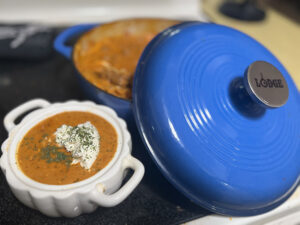
Spring is perfect soup weather. It’s easy, it’s quick, and many times you can leave it to simmer while you work outside. Around my house it is a staple as springtime is very busy on the farm! New baby animals being born, gardens to ready up, tend and plant and lots of other outside chores. Try these recipes on the stove top or in the slow cookeGardener’s Bootsr.

Spaghetti and Meatball Soup
2 tablespoons extra-virgin olive oil

1 carrot, peeled and chopped into a small dice
1 medium yellow skinned onion, chopped
2 small ribs celery chopped
3 cloves garlic, chopped
3 cups tomato sauce or 1 (14-ounce) can plus 1 (8-ounce) can
3 cups chicken stock, available in a box on the soup aisle
1 pound ground beef, pork and veal mix (meatloaf mix)
1/2 cup grated cheese, Parmigiano or Romano, plus more to pass at table
Read the rest of this post »

Email This Post Email This Post

Getting Ready for Food Preservation

Posted April 30th, 2008 by Melinda Hill
Categories: Baking and Cookery, Gardening, Homesteading

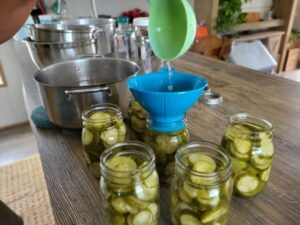
It’s been a long winter and it’s so exciting to see the trees begin to bud and the flowers pop through the earth. When the girls were younger we used to put up “things to look for in spring” like birds, bugs, flowers and other signs that yes, it’s truly spring. It’s also time to begin planning for what the garden will hold, how much I need tBeginner's Home Canning Kito plant to get the yield I might need for my family and friends.

Home food preservation is a strong practice in our community and valued as a tradition in many families. The planning, planting, tending, harvesting and preserving have come to mean many hours of family time together, working and enjoying the fruits of the yield. In the 2002 edition of the Ball Blue Book, there is a wonderful chart to help guide the planning process. It details the number of plants to purchase or plant for what yield. Another chart below  indicates the number of vegetables needed for a family of four, served how many times a week and then a final number of quarts that need to be preserved to achieve this goal. On the Ball web site (freshpreserving.com) under preserving guides they have similar planning charts to help us plan in greater detail the size and scope of our spring planting.
Read the rest of this post »

Email This Post Email This Post

Bearing It!

Posted April 30th, 2008 by Judith Costello
Categories: Homesteading

Koda, our blue and brown-eyed Heeler/Australian Shepherd, used to go outside to play with Bear, our lovable mutt. Bear may have the head of a Chow, but he has none of the testy qualities of that breed. The two dogs would run and play for awhile and then KoKoda and Bearda would be ready to come inside to resume her role as a pampered indoor dog. When our big Bear comes inside to spend the night in the back room, Koda expresses her presumed superiority. She nips him and tries to make sure he cannot move anywhere else in the house except to go directly to his room. I noticed recently that this herding behavior was becoming increasingly hostile. Koda was pulling out Bear’s hair. And all he did in response was cry.

Then a strange thing happened.
Read the rest of this post »

Email This Post Email This Post

Email Post Repaired

Posted April 26th, 2008 by Greg
Categories: Webmaster's Corner

Some of our readers that have tried to email an article to a friend using the link at the end of the article may have noticed the email does not get sent. This has been fixed, feel free to leave a comment if you experience problems.

Thanks, web master.